Punchayet to provide house to divorced Parsi
| ||
| ||
A man — embroiled in tenancy dispute
with his wife over a flat a sprawling flat at Cusrow Baug in Colaba in
south Mumbai — has got accommodation, thanks to the Parsi Punchayet.
The matrimonial dispute which would have gone on for years has been settled quickly with the involvement of the Parsi Punchayet, observed the Bombay high court on Wednesday. A division bench of justice PB Majmudar and justice AV Mohta said: “We appreciate the Parsi Punchayet for taking a humanitarian and practical approach.” As directed, Parsi Punchayet’s chairperson Dinshaw Mehta was present in court on Wednesday. The husband had been restrained by the single judge from entering the matrimonial house, pending divorce. He had challenged the order. Mehta told the court that the Parsi Punchayet will provide accommodation to the husband at Godrej Baug at Nepeansea Road. The wife has agreed to pay Rs1 crore refundable deposit to the Parsi Punchayet for the flat. The flat will be on leave and license agreement renewable every five years, Mehta told the court. Eighty per cent of the deposit is refundable if the husband decides to vacate the premises or dies. The high court said that in case the deposit is refunded, the Parsi Punchayet will give Rs25 lakh to the couple’s 11-year-old daughter. The husband has been allowed to stay in the Cusrow Baug flat until May 7 between 8pm and 10am. The couple has agreed to dissolve the marriage mutually. The child’s custody has been given to the mother. The high court has clarified that the order shall not be treated as precedent. “If it is treated as a precedent, then every Parsi couple involved in a dispute will ask for an alternative accommodation,” Mehta said. “All communities should adopt such practice (providing accommodation),” said justice Majmudar. However, he was quick to add that the Parsi community could work out such a system because they were few in number. | ||
|
Thursday, April 26, 2012
Punchayet to provide house to divorced Parsi


Alphonso price plummets, go ahead and dig in Increase in supply sends rates crashing to Rs1,000-Rs4,000 per box from Rs5,000-Rs10,000 a few days ago
Alphonso price plummets, go ahead and dig in
| ||
Increase in supply sends rates crashing to Rs1,000-Rs4,000 per box from Rs5,000-Rs10,000 a few days ago
| ||
 | ||
| ||
The king of fruits, Alphonso mango,
is not beyond your reach any more. The fruit is now available in the
range of Rs1,000 to Rs4,000 per box (peti) as against the price range of
Rs5,000 to Rs10,000 a few days ago.
One peti contains a minimum of four dozen and a maximum of 10 dozen mangoes. According to agriculture produce market committee (APMC) traders, an increase in the supply of mango led to the crash in the prices on the eve of Akshaya Trutiya. “Alphonso (happus) prices will go down even more now because of oversupply. In the coming week, one peti is expected to cost Rs700. Also, with only one more month of summer left, supply will increase tremendously, which will bring down the prices further,” said Sanjay Pansare, Vashi APMC director. He added that the prices started off high because the arrival of mango was delayed this year due to various reasons. The daily supply of mango in APMC is almost 63,000 petis from Ratnagiri, Sindhudurg, Dharwad, Hubli and some parts of Andhra Pradesh and Kerala. Because of the initial high rates, export of the fruit was low as well. “We hope the demand in the Gulf, England and America picks up soon. People can now afford to buy mango. We generally supply 25-30% mangoes to foreign countries and the remaining yield gets sold out in Mumbai and its adjoining places. The next 15 days are crucial for business,” Pansare told DNA. Besides Alphonso, supply of Badami, Totapuri, and Lalbaug has also increased. Totapuri is sold at Rs40 to Rs90 per kg, Lalbaug at Rs15 to Rs20 per kg while Badami at Rs30 to Rs40 per kg. “The rate depends on the demand and supply of the fruit. Earlier, people used to only ask about the mango rates. Now, they can buy and take the sweet fruit home,” said Ramakant Tandel, a seller at Nerul, Navi Mumbai. | ||
| ||


Banks adopted various ways to sell illegal and ‘exotic’ derivatives in their profit pursuit, bypassing the Reserve Bank of India’s (RBI) guidelines and causing losses of as much as Rs34,000 crore,
Banks used exotic means to hoodwink Reserve Bank
| ||
Banks adopted various ways to sell illegal and
‘exotic’ derivatives in their profit pursuit, bypassing the Reserve Bank
of India’s (RBI) guidelines and causing losses of as much as Rs34,000
crore, which they then tried to cover up by forging documents, DNA
investigations have found.
Banks sold these contracts to gullible companies, taking advantage of a depreciating dollar against the rupee, and offering exporters what they needed — an alternative to offset their currency losses. In 2007, the rupee rose rapidly to Rs39 from around Rs50 per dollar, causing panic among Indian exporters who feared loss of revenue - they were getting less rupees for their dollars. And as the dollar continued to fall, banks started wooing clients via e-mails, even sending company executives on free holiday trips to Singapore, Thailand and South Africa to convince them to buy these derivatives. DNA has access to several such e-mails and documents which show how banks brazenly violated RBI guidelines. In 2006 and 2007, under the pretext of a conference, ABN Amro took executives on a free five-day tour of Thailand and Malaysia. “The conference was attended by about 100 such representatives of several companies from India where they were explained about derivative (exotic) products,” as per an affidavit by I Venkateswarlu, executive with Tiruppur-based Armstrong Knitting Mill. DNA has reviewed the affidavit. Subsequently, he bought these derivatives in 2007, which led to a loss of Rs27 crore. S Dhananjayan, a chartered accountant from Tiruppur, said two of India’s biggest banks took their clients on a fully-paid trip to Cape Town, South Africa, Singapore and other places. Some banks even put up hoardings in Tiruppur emblazoned: “Suffering from forex losses? Come to us, we have a solution”, while others preferred to draw customers by sending personalised e-mails and attractive presentations. Banks’ particular interest in Tiruppur companies can be attributed to the fact that Tiruppur is a leading source of hosiery, knitted garments, casual wear and sportswear exports for India, and therefore, a major source of foreign exchange for the country. The city accounts for 80% of India’s cotton knitwear export, worth an estimated US$2 bn. Besides Tiruppur, exporters in Mumbai, Hyderabad, Ahmedabad and a few other cities were also targeted by the banks to sell exotic derivatives. Early 2007, Rajith Kumar Naidu of State Bank of India, Chennai, sent an e-mail to a Tiruppur-based exporter saying, “Please find attached some very interesting structures with potential to earn huge profits... Please call me for further clarification.” In the next e-mail, Naidu claimed that these derivatives have “strong possibility of making profits”. Further, banks used a template of contracts to avoid procedural delays and finalise the deals quickly. For instance, ICICI Bank signed a contract which was meant for a company with a Tiruppur-based partnership firm to quickly set the process rolling. In many cases, even the important sections of the contract agreement were left blank. DNA accessed many copies of such contracts. The other strategy that banks followed was holding exclusive seminars on how derivatives are an easy option of making profits and offsetting losses due to fluctuating forex rate, said Dhananjayan. The RBI guidelines said banks should carry out due diligence to ensure that each derivative transaction is suitable and appropriate to a customer’s requirements. However, none of these banks followed it in principle, and encouraged corporates to sign deals that were purely speculative in nature and, without a doubt, inappropriate for the business. In this regard, the RBI had written a letter to CBI on October 27, 2009, listing 10 rules, under the Foreign Exchange Management Act and RBI, which these banks flouted while selling derivatives during 2007-08. Since the deals were formed without underlying assets, as soon as the issue was highlighted in media, banks made traders sign some underlying papers to cover up the fraud. For example, one R Senthilvel of ABN Amro, sent an e-mail on November 7, 2008, to Cylwin Knit Fashions of Tiruppur, saying “Take printouts of the attached (an order sheet document of an unknown trader) and affix a seal of Cylwin and sign and give to us.” However, the order sheets were not pertaining to Cylwin at all. If that were not enough, banks forced and intimidated exporters to sign documents at the end of the financial year 2009 in a rush to convert derivative losses into corporate loans. “In fact, in one exporter’s case, the documents converting the loss into a loan were signed at midnight on March 31, 2009,” said Raja Shanmugam, president of Forex Derivative Consumer Forum. In 2009, the central bank directed all the banks to maintain a separate account for losses due to exotic derivatives, yet many banks didn’t. DNA is in possession of many letters exchanged between SBI and exporters, where exporters appealed to Tiruppur branch of SBI to implement the RBI direction, but the largest public sector bank did not. The matter has been pending with the Supreme Court for more than two years now. |
Milkmen in New Delhi protest against the decision of companies making dairy products to reduce the purchasing price of milk
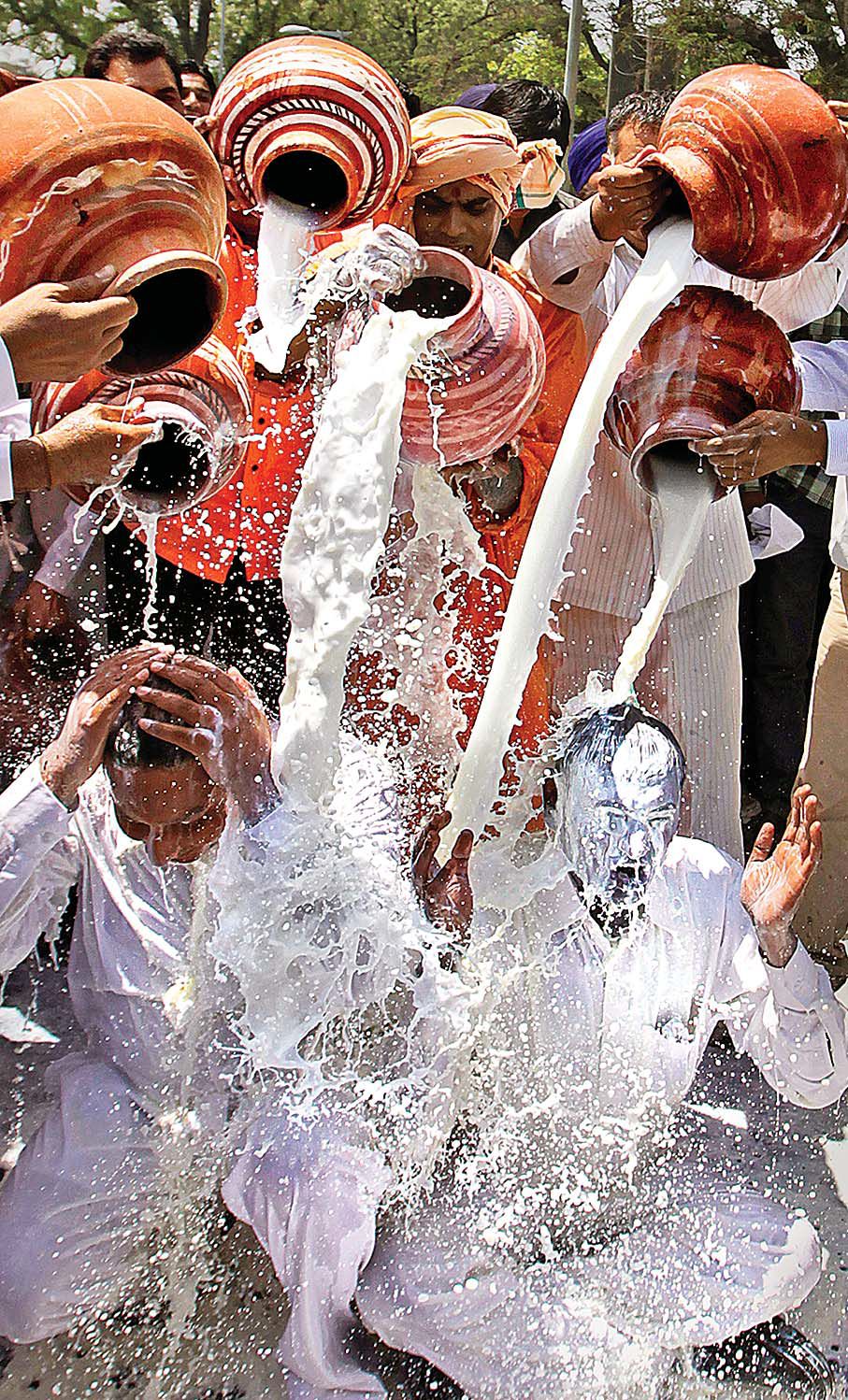
MILKY WAY TO PROTEST
Milkmen in New Delhi protest against the decision of companies making dairy products to
reduce the purchasing price of milk, on Wednesday
Wednesday, April 25, 2012
पंढरीचा पांडुरंग भगवान बुद्धच!
पंढरीचा पांडुरंग भगवान बुद्धच!
पंढरीचा पांडुरंग हा प्रत्येकाला आपला वाटत आला आहे. मग याच मातीतले संस्कार पचवणारे बौद्धधर्मीय त्याला अपवाद कसे असणार. पंढरपूर हे बौद्ध तीर्थक्षेत्र असल्याचे दावे ऐतिहासिक संदर्भ आणि खुद्द संतकवींच्या रचना यांच्या आधारे नेहमीच केले जात आहेत. .............................. गेली अडीच हजार वर्षे भगवान बुद्ध आपणा भारतीयांचा मार्गदर्शक राहीला आहे. त्याच्या प्रभावापासून त्याच्या कडव्या विरोधकांनाही कधी मुक्त होता आले नाही. बुद्धाची तात्त्विक उसनवारी करीतच त्यांना आपला प्रपंच प्रतिष्ठित करावा लागला. इतकंच नव्हे तर भगवान विष्णूच्या दशावतारांचा इमलाही त्यांना बौद्ध सिद्धांताच्या पायावरच उभारावा लागला. त्यांनी बुद्धाला विष्णुचा अवतार मानले आणि त्यांनीच बुद्धाला शिव्याशापही दिले. इतिहासात इतिहासात बुद्धासंतांवर शस्त्र-शास्त्रांच्या माध्यमातून अनेकदा आक्रमणं झाली. पण ती सर्व आक्रमण पचवून बुद्ध जगभर पसरला. भारताला गौरवांकित केले. बुद्धाच्या हयातीतच महाराष्ट्रात बुद्ध धर्माचे आगमन झाले होते. त्यानंतर पंधरा-सोळाशे वर्षे तो इथे बहरत होता. त्याच्या तात्कालीन वैभवाच्या शिल्पखुणा महाराष्ट्रातील प्रत्येक पर्वतराजी उरीपोटी बाळगून आहे. बौद्ध धर्माच्या इतिहासात महाराष्ट्राची कामगिरी अत्यंत भूषणास्पद आहे. सांप्रत भारतात जवळपास १२०० बौद्धलेणी आहेत. त्यातील ७०० पेक्षा जास्त लेणी एकट्या महाराष्ट्रात आहेत. काही लेण्यांवर बौद्धेतर कब्जा करुन बसले आहेत तर काही बौद्ध विहारांचे मंदिरात रुपांतर करण्यात आले आहे. पंढरपूरचे विठोबाचे मंदिर हे त्याचे एक उदाहरण आहे. इसवी सनाच्या आठव्या शतकातील पुराणींनी बुद्धाला विष्णूच्या दशावतारात स्थान दिले. महाबलीपूरम येथील एका शिलालेखात बुद्ध विष्णूचा नववा अवतार असल्याचे लिहिलेले आहे. हा शिलालेख आठव्या शतकातील आहे. वेरुळ येथील दशावतरांची लेणीही आटव्याच शतकातील आहे. आर. सी हाजरा विष्णूच्या दशावतारांची निश्चितक्रम परंपरा (मत्स्य ते कल्कि) आठव्या शतकापासूनच सुरू झाल्याचे सांगतात. आठव्या शतकातील राष्ट्रकूट - चालुक्य राजवटीतील एका शिलालेखात त्याचा मराठीत अर्थ होतो. ' टेकडीवरचा पांडुरंग ' असा उल्लेख आहे. यावरुन पंढरपूरचा विठ्ठल पांडुरंग म्हणून आठव्या शतकापासून ओळखिला जात असावा असे वाटते. परंतु या पांडुरंगाला अत्यंत लोकप्रिय केले ते मात्र मध्ययुगीन मराठी संतकवींनी. त्याला कारणही तसेच बलवत्तर होते ! भारताचा मध्ययुगीन इतिहास हा परकीय आक्रमकांचे भयानक हल्ले, कत्तली, त्याबरोबरच धार्मिक आणि सांस्कृतिक विनाशाचा इतिहास आहे, हे काही अंशी खरे आहे. तरी त्यामुळेच आक्रमकांच्या मुळे का होईना, सनातन्यांनी चालविलेल्या कर्म छळाला शह बसला होता. म्हणूनच भारतीय इतिहासातील सध्यकाळ मूलतः पतन काळ होता, असे म्हणता येत नाही. कारण याच मध्ययुगात संतकवींनी उभी केलेली भक्ती चळवळ ही एक युगांतकारी घटना होती. महाराष्ट्रात या चळवळींचे नेतृत्त्व ज्ञानेश्वर - ज्ञाती बहिष्कृत ब्राम्हण (१२२९-७२), नामदेव- शिंपी (१२७०-१३५०), एकनाथ- ब्राम्हण (१५३३-९८), तुकाराम वाणी (१५२९-७२), नरहरी - सोनार, सावता - माळी, गोरोबा - कुंभार, सेना - न्हावी, चोखोबा - महार, शेख महंमद -मुसलमान, तुकाराम शिष्या बहिणाबाई - ब्राम्हण आणि कान्होपात्रा - नर्तकी इत्यादींनी केले. काही अपवाद वगळता हे सर्वच संतकवी बहुजन समाजातील होते. वरील सर्वांनाच सनातनी अत्याचारांच्या अनुभवातून जावे लागले होते. चातुर्वर्ण्य ब्रम्हाने वा कृष्णाने निर्माण केले असेल पण म्हणून का स्त्री, शूद्र, अतिशूद्रांना गुराढोरांसारखे वागवायचे ? आम्हालाही माणसांसारखे वागवा असा संतांचा आग्रह होता आणि तो त्यांनी चातुर्वर्ण्याच्या चौकटीत राहूनच व्यक्त केला ! तरीही ब्रम्हवृंदांचे वर्चस्व असलेली धर्मसत्ता पाझरली नाही. शेवटी माणुसकीला पारखी झालेली बहुजन जनता पांडुरंगाला शरण गेली. त्यांची समतेची आणि ममतेची भूक करुणासागर पांडुरंगाने भागविली. तेव्हापासून संतांचा - भक्तांचा मेळा पांडुरंगाभोवती गोळा होऊ लागला. या करुणाकराची करुणा भाकताना भक्तांनी भगवंतांला कधी ' माऊली ', कधी ' बा ' तर कधी 'राया ' म्हणून पुकार केला. भगवंताचा आणि भक्तांचा हा सोयर संबंध आता एका विशाल संप्रदायात परिणाम झाला आहे. भगवंताचे दारी पंढरीची वारी करण्यासाठी भगवंत आणि भक्त वारकरी पंढरपूरी मोठ्या श्रद्धेने येत असतात. शेकडो वर्षांपासून चालू झालेला हा जनाचा प्रवाह आज बहुजनांची वहिवाट झाली आहे. आज पंढरीची वारी करणारे वारकरी पांडुरंगाला विश्वरुप मानत असो वा शिव रुप मानत असोत वा विष्णू शिवाचे एकात्म रुप मानत असोत. पण संतश्रेष्ठ एकनाथ महाराज आणि संत शिरोमणी तुकाराम महाराज मात्र पंढरीच्या पांडुरंगाला बुद्धरुपच मानत होते. एकनाथ महाराज आपल्या अभंगात म्हणतात. लोक देखोनी उन्मत्त वारानी आसक्त । न बोले बुद्धरुप ठेवीले जयनी हात ।। संत तया दारी तिष्ठताती निरंतरी । पुंडलिकासाठी उभा धन्य धन्य विठ्ठल शोभा । बौद्ध अवतार घेऊन विटे समाचरण ठेवून ।। धर्म लोपला अधर्म जाहला हे तू न पाहसी । या लागे बौद्धरुपे पंढरी नांदसी ।। संतशिरोमणी तुकाराम महाराज आपल्या एका अभंगात म्हणतात बौद्ध अवतार माझिया अदृष्टा । मौन्य सुखे निष्ठा धरियेली ।। वरील अभंगावरुन संतश्रेष्ठ विठ्ठलालाच बुद्धरुप मानत होते हे स्पष्ट होते. संत साहित्यावर बौद्ध मताचा प्रभाव का आहे, याचे उत्तर या अभंगात आहे. मराठी संत कवींच्या उदयापूर्वीच महाराष्ट्रात बौद्धधर्माचा - हास झाला होता तरी बुद्धसंत मात्र बहुजन मानसात तग धरुन होते म्हणूनच संत साहित्यातून ते अभिव्यक्त झाले. मा. शं. मोरे आपल्या महाराष्ट्रातील ' बुद्धधम्माच् या मंदिराच्या सभामंडपातील दगडी खांबावर ध्यानस्थ बुद्धाच्या कोरीव मुर्ती असले, वारकरी संप्रदायात प्रवेश करताना जी शपथ घेतली जाते ती बुद्धाचे पंचशील असणे. वारकरी संप्रदायातील लोकांनी निदान पंढरपूरपुरतं तरी जातिबंधनं, श्रेष्ठ - कनिष्ठता न पाळणे. कारण, जातिभेद नष्ट करणे ही बुद्धाची शिकवण आहे. पंढरपूरची यात्रा आषाढी पौर्णिमेस करणे कारण त्यादिवशी तथागतांनी पंचवर्गीय भिक्खुंना पहिले प्रवचन देऊन धर्मचक्र प्रवर्तन केले होते. बुधवारच्या दिवशी पंढरपूर न सोडणे, विठ्ठल पितांबरधारी असणे कारण बुद्धाने स्वतःसाठी व भिक्खुंसाठी पिवळे व वस्त्र धारण करण्याचा नियम केला होता. याच ग्रंथात मोरे यांनी वासुदेव गोविंद आपटे यांच्या ग्रंथातील मजकूर उद्धृत केला आहे. त्यात ' विठोबाची मूर्ती खडकावर खोदलेल्या बुद्धमुर्ती, याच्या स्वप्नातील सदृश्य व विठोबा - रखूमाई यांची पृथक पृथक मंदिरे असणे, गोपाळकाल्याच्यावेळी जातीभेदाला फाटा देणे या गोष्टी सांप्रदायिक पद्धतीला सोडून आहेत. यावरुन हे क्षेत्र मूळचे बौद्ध असावे. बौद्ध धर्माच्या -हासानंतर बामण धर्माने त्या मूळच्या बौद्ध धर्माच्या आपल्या धर्मात समावेश करुन घेतला परिस्थितीजन्य पुरावा पहाता आजचे विठ्ठल मंदिर हा बौद्धांचा विहार होता त्याचे हिंदूकरण करण्यात आले हा त्यांचा निष्कर्ष अगदी योग्य आहे. डॉ. आ. ह. साळुखे (सर्वोत्तम भूमिपुत्रः गोतम बुद्ध) यांनी डॉ. रा. चिं. ढेरे यांच्या ' श्री विठ्ठल महासमन्वय ' या ग्रंथातील काही वाक्य उद्धृत केली आहेत. डॉ. ढेरे लिहितात ' मराठी संत साहित्यात विठ्ठल हा बुद्ध असल्याची धारणा जशी वारंवार शब्दात प्रकट झालेली आहे तशीच ती महाराष्ट्रात चित्र आणि शिल्प या माध्यमातूनही प्रकट झाली आहे. महाराष्ट्रात शिळाप्रेसवर पंचांगे छापली जाऊ लागल्यावर दिर्घ काळपर्यंत पंचांगांच्या मुखपृष्ठावर नवग्रहांची अथवा दशावतरांची चित्रे छापीत असत. या दशावताराच्या चित्रात नवव्या अवताराच्या स्थानी सर्वत्र न चुकता विठ्ठलाचे (एखाद्याचे अथवा रुक्मिणीसहीत) चित्र छापलेले दिसते. आणि त्याबाबतीत आपल्याला कसलीही शंक उरू नये, म्हणून त्या चित्रावर बुद्ध वा बौद्ध असे नावही छापलेले आठवते.... दशावतारातील बुद्धाच्याजागी विठ्ठल असल्याची दोन तरी शिल्पे मला माहीत आहेत. एक तासगाव (जिल्हा सांगली) येथे विंचूरकरांनी बांधलेल्या दक्षिणी शैलीच्या गणेश मंदिराच्या गोपूरावर आहे आणि दुसरे कोल्हापूरच्या महालक्ष्मी मंदिराच्या प्रकारातील एका ओवरीत आहे. जानोबा-तुकोबांनी ज्या इंद्रायणीच्या प्रवाहातून वैश्विक करणेचा महापूर महाराष्ट्रभर पसरविला. त्या इंद्रायणीचा उगम तथागताच्या करुणामय जीवितातून स्फूर्ती घेणा-या असंख्य भिक्षुंच्या निवासभूमीत झाला आहे, हे सत्य सहजी डावलता येण्यासारखे नाही. डॉ. बाबासाहेब आंबेडकरांना आपली पत्नी रमाबाईची पंढरीला जाण्याची इच्छा पूर्ण करता आली नाही. पण बौद्धाची स्वीकारापूर्वीचे त्यांच्या मनात पंढरीच्या विठ्ठल बुद्धरुपच असल्याचे पक्के झाले होते. आपल्या एका भाषणात त्यांनी ' पंढरपूरच्या विठोबाची मूर्ती ही वस्तुतः बुद्धाची आहे. आणि या विषयावर मला एक प्रबंध लिहायचा आहे. तो पूर्ण झाल्यावर पुणे येथील भारत संशोधन मंडळाच्या पुढे मी तो वाचणार आहे. विठ्ठलाचे पांडुरंग हे नाव पुंडलिक या शब्दापासून बनलेले आहे. पुंडलिक म्हणजे कमळ आणि कमळालाच पालीमध्ये पांडुरंग म्हणतात. म्हणजे पांडुरंग दुसरा कोणी नसून बुद्धच होय. ' मार्च १९५५मध्ये त्यांनी या विषयावर प्रबंध लिहायला सुरुवातही केली होती. परंतु पुढे हा प्रबंध अपुराच राहीला अशी नोंद त्यांचे चरीत्रकार धनंजय कीर यांनी केली आहे. संत शिरोमणी एकनाथ - तुकाराम यांनी विठ्ठलाला बुद्धरुप मानले आहे. विद्वानांनी विचारवंतांनी त्याला पूरक असे संशोधन केले आहे. त्याचा निष्कर्ष पंढरीचा पांडुरंग भगवान बुद्धच आहे याची खात्री पटविणार आहे. -विशू काकडे |
INDIA LEAVE HITLER DISGUSTED
|
INDIA LEAVE
HITLER DISGUSTED
|
||
About 40,000 people — by far the biggest turnout at any Olympic hockey match — had gathered. In attendance was Adolf Hitler. India continued to score at will and took a 6-0 lead. A disgusted Hitler left midway. The Germans then decided to play rough and went after Dhyan Chand. A cynical tackle by the German goalkeeper cost the India captain a tooth. But Dhyan Chand returned to the field after receiving attention and instructed his team to go easy. As the stunned crowd watched, India repeatedly took the ball up to the German circle and then ‘back-passed’ to mystify their opponents. But the damage was already done. India beat Germany 8-1 to complete a hat-trick of gold medals. It was at this Olympics that Dhyan Chand was bestowed with the ‘legend’ status. A sports club in Vienna built a statue of Dhyan Chand with four hands and four sticks! There was an interesting incident involving Dhyan Chand and Hitler, but that’s for later. Watch this space. |

 |

|

Adding a personal touch to retail can work wonders for sales Replicating similar experiences to shoppers over the Internet, however, remains a tough challenge for players
Adding a personal touch to retail can work wonders for sales
| ||
Replicating similar experiences to shoppers over the Internet, however, remains a tough challenge for players
| ||
So, we stopped at the first clean place we found on the side of the road. It was a Sunday morning and the place was empty. The waiter seemed genuinely happy to see us. Perhaps, they greet the day’s first customers that way, or maybe the courtesy is extended to everyone. As we sat down, the owner came over and asked with enthusiasm how he could serve us. Now, we weren’t big-ticket customers, all we wanted was Strawberry Cream, but he was excited to have us and promised us the best in town. We were happy with the serving. And as we ate, he came over with a bowl of strawberries freshly picked from his back garden. We hesitated, but he insisted that we ate some. When the bill came, we noticed he hadn’t charged us for it! This was a small road-side restaurant, and the staffers most definitely hadn’t been formally trained. But because of the owner’s attitude, the waiters were eager to serve and we had a more memorable dining experience than any restaurant or hotel in the city. The next time I am in Mahabaleshwar, I will definitely go back. The experience got me thinking. We live in a country of owner-run retailers and I wondered whether most of them operate like this and whether it really helps them increase sales. I remembered the story a friend in the US who shared his knowledge about a neighbourhood book shop. The owner has a deep knowledge and love for books and is always around to make suggestions on what to read next based on what customers had last shopped for. And then, he does something else. While handing you your book and change, he leaves you with a phrase — a command — to come back. “You’ll come back for more soon!” he says confidently and plants a seed of satisfaction that usually turns into return sales. Most small retailers work with specific tricks and practices to engage with their customer base and continue to grow their sales through goodwill generated and word of mouth. But these are small stores and most have owners who are present on the shop floor every day. So, is it possible to adopt similar practices in modern retail, where most stores are fronted by employees? That depends on whether people running these stores believe that delivering personal experiences will get customers engaged with their brand. And that eventually, this brand engagement will increase their sale, allowing them to beat their targets at a much lower cost. A business advisor and colleague runs a fresh fruit and vegetable aggregation and distribution business. On a routine store visit in Pune, he found that a store manager was struggling every day to sell his quota of grapes. It was identified that only 14% of that store’s customers were buying fruits and vegetables in the store. So, he asked that the grapes be made available for tasting at various shopping points, including at the check-out. The first day they implemented this, the store was out of stock by 3pm! This trick, which cost the store absolutely nothing, also helped them increase their daily sales of fruit and vegetables thereafter. Most of these practices can be implemented at no extra cost if the importance of delivering shopping experiences takes centre stage within the operational practices of modern retail. Business leaders running these businesses have to adopt this as a core strategy of running a successful and profitable retail business. At KLISMA, for example, our philosophy is simple: there is no single rule when it comes to meeting customer satisfaction. Each associate is at liberty to make his/her own decisions to deliver desired shopping experiences. However, bringing similar experiences to shoppers over the Internet is a unique challenge of our times. The key here, for multi channel retailers, will be to build technological tools that enable shoppers to have similar shopping experiences. One way of doing this could be by giving online grocery shoppers a sabzi mandi experience. There could be a tool that would let them bargain for the price of 2kg of potatoes, pick the size of bhindi they prefer, or ask for free dhaniya and mirchi once their basket is full. This is just one example of providing a purely Indian offline shopping experience to a website, converting e-commerce into experience commerce! In this country, with several people just getting used to the concept of paying online, the scope for such developments is large. All that modern retailers need to ask themselves is why we enjoy shopping in a market, and then translate that into a virtual experience. The writer is chief customer experience officer at Klisma, India’s first experience commerce platform. He can be reached at ajay@klisma.in |

 |
Buying grocery now has a tech edge
Buying grocery now has a tech edge
|
||
Basically, it operates in the same way as you do railway or air bookings. But what takes the cake is there are no extra costs involved and the products get delivered right at your doorstep. What augurs well for the consumer is the competition is building up as more and more players try to wean away customers by lining up hefty discounts and other promotional features in an attempt to corner a bigger chunk of market share. Shailaja Sharma takes a closer look. When Vikrant Joshi, an advertising professional in Mumbai, stopped by the kirana store in his locality for a loaf of bread and some eggs, he was in for a pleasant surprise — the shopkeeper informed him that he could order his supplies online which would be home delivered. On top of it, the shopkeeper followed up his chat by offering his business card which carried the website address to place such orders. Joshi’s neighbourhood fuddy-duddy kirana store is part of about 1,600 others across the country that are now delivering groceries at consumer door-steps through orders placed on AaramShop.com, a company that partners with local kirana and medical stores to sell food and grocery online. With a footprint across 24 cities, AaramShop is now looking to bring in 20,000 shops under its coverage to become the largest e-grocer in the country. The modus operandi is like this. When a consumer makes an order on the website, he can select the shop nearest to his home for delivery. The shopkeeper is alerted about the order through an e-mail followed by an SMS and a call from AaramShop’s call centre. The waiting time is around 3-4 hours before the order can be delivered. Unlike a typical e-commerce transaction, the company does not charge anything from the kirana stores or even from customers. Instead, it is looking to make money directly from brands by providing them with analytics of consumer behaviour so that they can figure out buyers’ brand preference. AaramShop is not sitting on its laurels, which is launching Aaram TV, a concept for in-store advertising of brands where product companies can pay for advertisements to be run on screens at mom-n-pop stores so as to attract consumers. Up next are mobile apps for kirana store owners which will alert them about orders on their mobile screens. Vijay Singh, chief executive officer and MD, an entrepreneur for 15 years, started AaramShop last year, along with a team of friends. The funds are flowing, with Bangalore-based grocery e-tailer bigbasket.com recently securing some venture capital funding. A host of other websites like mygrahak.com and easyration.com in Delhi NCR, kiranawalla.com in Bangalore, freshndaily.com in Mumbai and chennaionlinegrocery.com in Chennai are already selling food, grocery and fresh supplies with free delivery within 24-48 hours of order, cash on delivery facility and discounts. On an average, a city household spends Rs.4,000-5,000 a month on groceries. Retailers believe the top 20 towns offer huge growth potential as spends on FMCG products are seen going up. According to KPMG’s calculations, food and grocery retail in India is currently estimated to be $250 billion in size and expected to grow at rate of 6-8% on real term basis. Of this market, share of organised retail is estimated to be only 3% currently, but likely to double to 6% by 2015-16. But the point is why would consumers use the web instead of making a call to their local kirana store. Ashutosh Malik, director and chief operating officer, AaramShop, points to the hectic schedule of the working class which finds ordering its weekly supplies online an easier option. For the traditional retailers, this is an opportunity to bolster sales. “The neighbourhood has over the years seen a slump in orders. They understand the competition from modern trade and are embracing the technology to stay ahead,” adds Malik. He points to the format’s convenience factor when he says even FMCG companies are excited by a model like AaramShop as it provides them with last mile connect with consumers. Companies can communicate to buyers directly at the point where the purchase is being made. AaramShop is banking on these consumer brands to advertise on its site and buy into the data it collates from the cities it caters to. When consumers order for products with a call to their kirana store, the average order size is at about Rs.200. But while buying online, consumers are able to do impulse purchases, with as many as 30 product categories, Malik says. “An average order on our site is Rs.570,” he says. The road ahead is not without some sticking points though. “Online retail becomes popular in categories that can offer convenience, comparison and price advantage. Although online retail presents a significant potential, food and grocery online retailing has significant challenges related to managing the supply chain, low margins and limited shelf-life of fresh produce,” said Mohit Bahl, partner, KPMG, transactions services. In Bahl’s view, penetration of online food and grocery formats in mature markets has been limited, with major hurdles being supply chain-related issues. Some experts say even as Indian consumers have comfortably adopted online stores for their apparel and electronics purchases, grocery is a different ballgame as consumers prefer to handpick their food and items of daily necessities, whether it’s scurrying across store aisles or ordering weekly supplies over the phone. Malik of AaramShop admits that a majority of online grocery formats have failed to take off in a big way in many markets — these have stumbled in the US even. Unlike books which come with higher margins, grocery retailing fetches margins below 15% and usually in single digits. That, coupled with challenges in setting up an orderly supply chain, makes the model unviable. |


Angre Port opens, plans ship-repair ops
Angre Port opens, plans ship-repair ops
| ||
Close to `520 crore has been invested in developing the port facility, which has a draught of 10 metres and can currently handle a cargo of around 16 million tonne per annum. In the second phase of development, the port plans to increase the draught to 13 metres and the capacity to 25 mtpa. The port would focus on all types of clean cargo (which does not pollute). The proposed ship-repair unit will have six berths and would be the only such major facility on the west coast. “In the long term, we expect the ship-repair facility to bring in more revenue than the port,” said M P Patwardhan, managing director, Chowgule Ports and Infrastructure. “There are close to 500 Indian flagged vessels below 10,000 dwt (deadweight tonnage) plying on the west coast which require dry docking every 30 months,” Patwardhan said, adding the port is capable of handling all types of cargo— container, bulk and liquid. The company is in talks with oil companies for setting up tankage facilities and starting a bunkering service. Company officials said these plans will fructify in six months. The port will be operated under the build-own-operate-share-transfer model for a concession period of 50 years with the Maharashtra Maritime Board. In the long run, the company will also explore other landlord models, under which space could be leased out to players from allied activities segments to set up facilities at the port. The port has a total area of more than 320 acre. |

Kashmir voted best emerging tourist destination of India
Kashmir voted best emerging tourist destination of India
| ||
Jammu and Kashmir was chosen for the coveted honour after people voted for it in the polls, both online and in the magazine, held across India. The organisers have invited the J&K tourism functionaries to receive the award on May 3 in Mumbai, an official spokesman said. “The editor of the magazine in his communication to commissioner/secretary tourism and culture, Atal Dulloo, said that given the importance and scope, the awards will also be covered in the UK edition of the Lonely Planet Magazine,” an official spokesman said here. The honour comes at a time when Kashmir is all set to host two million tourists this year. Last year, more than 1.3 million tourists visited Kashmir. This excludes 6.33 lakh pilgrims who visited the Amarnath cave shrine in 2011 summer. “This vote will help us further promote J&K as the best destination in the country. J&K as a whole has bagged the honour and each three region of the state has its importance. If Kashmir is rich in natural beauty, Ladakh is the adventurists’ paradise. Similarly, Jammu too has great richness in pilgrim and other tourism,” said Farooq A Shah, director of tourism, Kashmir. The honour comes two years after the famed winter resort of Gulmarg was declared seventh top ski resort in Asia by CNN International. Gulmarg has been recommended by CNN International as one of the best ski destinations for downhill thrills, which attracts visitors from across the globe. The vote has instilled new hope among tourism players that the West will now revisit the advisories cautioning its people over visiting Kashmir. “These adverse advisories are affecting us a lot. Since Lonely Planet has voted J&K as best destination we hope that the West will now revisit the advisories and allow its people to visit the valley,” said GM Dag, chairman J&K Tourism Alliance, an apex body of the tourism players in the state. The J&K government too has pitched for lifting the advisories since Kashmir is now safe for all kinds of tourism. “Germany has lifted the advisory and UK has relaxed its advisory. Now we hope other countries will follow the suit,” said Shah. Tourism sector is currently doing roaring business with tourists’ bookings shooting up 80 to 90% in the valley. “However, the exorbitant air tickets and less number of seats available in airplanes are affecting the arrivals,” said Dag. |

Subscribe to:
Posts (Atom)
Popular Posts
-
Click here to see Original Photo Chhatrapati Shivaji Maharaj - Great Maratha King
-
Click here to see Original Photo Chhatrapati Shivaji Maharaj - Great Maratha King Shiwaji weapons
-
1 Land, Politics And Trade In South Asia: 2 Leadership In 21st Century: 3 Truth Is Multi Dimensional-CD Sri Sri Ravishankar Art 4 What ...
-
Click here for More articles Rashichakrakar Sharad Upadhye - Bhakti Sagar आखाडा का बखेडा? : शरद उपाध्ये - Rashichakra Sharad Upadhy...
-
Kokanatala Malvani Garana Garhana marathi garhane कोकणात देवाला गार्हाणं घालण्याची रीत अजूनही प्रचलीत आहे.चांगल्या प्रसंगी देवाची आठव...
-
आषाढी (देवशयनी) एकादशी इतिहास पूर्वी देव आणि दानव यांच्यात युद्ध पेटले. कुंभदैत्याचा पुत्र मृदुमान्य याने तप करून शंकराक...
-
स्त्रीला गरोदर कसे करावे ? पाहण्यासाठी येथे या मातृत्व प्रत्येक विवाहीत स्त्रीच्या आयुष्यात मातृत्व प्राप्त होणे ही अत्यंत आनंदाची तस...
-
 Marathi Bold Actress Amruta Khanvilkar When Amruta Khanvilkar was the losing fina...
 -
 CLICK HERE TO VIEW THIS INFORMATION
 -
 सुरस कथा मार्केटिंगच्या Dhirubhai Ambani Marketing Story in Marathi कथा धिरुभाई अंबानी यांचे वडील गुजरातमधे ग्रामीण भागात प्राथमीक शीक...
